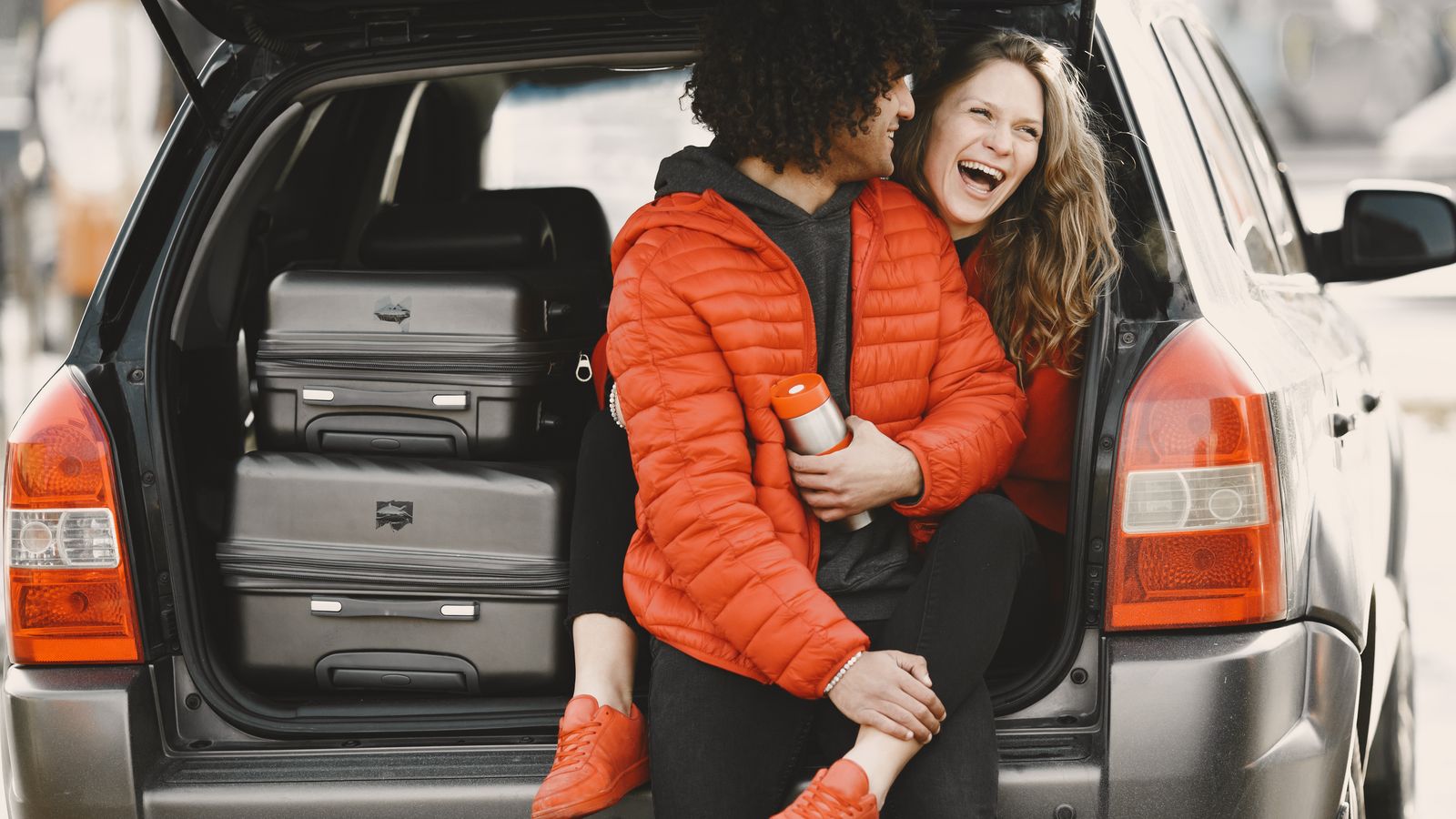
Most packing lists fail in the same way: they try to be complete instead of useful. A road trip has no baggage allowance forcing you to choose, which sounds like freedom right up until the car is packed to the roof and you’re repacking it every morning to find a phone charger. The useful question isn’t what you could bring: it’s what you’ll actually reach for, and whether you can get to it without unloading the trunk.
So this checklist is organized the way you’ll use it: by category, and by when you’ll need each thing. Some items ride in the suitcase; some live in the car and never leave it; and a small handful need to stay within arm’s reach the whole drive. Getting that separation right matters more than the length of the list. The method behind all of it is the same one we use in our guide to planning a road trip: bring less than you think, and keep what you bring organized.
Documents and money: the things a trip stops without
Start with the small category that can end a trip if it’s missing: your driver’s license, the car’s registration and proof of insurance, a form of ID, and at least two ways to pay. If you’re renting, add the rental agreement and the card the booking is under. None of it takes space, and all of it is the kind of thing you only remember at a checkpoint or a counter.
Keep physical backups of anything you’ve booked: a printed or offline copy of hotel and campsite confirmations, and a written note of a couple of emergency contacts. Phones die, signal drops in exactly the remote places where you’d need a booking reference, and a screenshot you can’t open is no better than nothing. Put this whole category in one folder or pouch you don’t have to dig through.
The car kit: what stays with the vehicle
A second category never moves from the car: the safety and recovery gear you hope not to touch. That means jumper cables or a jump pack, a tire inflator and pressure gauge, a flashlight, a basic first-aid kit, and a phone mount and car charger. Because this list deserves its own treatment, we’ve covered it in full in our guide to road trip essentials to keep in the car. Pack it once, leave it in the trunk, and stop thinking about it.
Alongside it, keep the navigation fallback: offline maps downloaded for the regions you’re crossing, or a paper atlas. Large stretches of national parks and rural highway still have no signal, and a route that depends on a live connection can fail exactly when you need it.
Clothing: bring less than you think
Clothing is where overpacking does the most damage, because it’s the easiest category to talk yourself into. Pack for the climate at your destination and the length of the trip, in layers you can add and remove as the weather changes, not for every hypothetical occasion. A week’s trip rarely needs more than a few days of outfits; a load of laundry halfway through costs an hour and frees up half your bags.
Build around versatile pieces that mix and match, add one warmer layer than you think the forecast calls for, and keep a single set aside for anything nicer you might do. Shoes are the classic trap: two pairs that cover everything beat five that each do one thing. And keep one change of clothes somewhere you can reach without opening the main luggage. Spills and weather don’t wait for the next hotel.
Food, water, and the cooler
A cooler is one of the highest-value things you can pack. Water for everyone in the car, a stock of snacks, and a few easy meals cut both the cost and the time lost to stopping: you eat when you’re hungry instead of when the next town appears, and you’re not paying gas-station prices for it. It’s the same logic that keeps food from quietly wrecking a budget in our planning guide.
Carry more water than feels necessary, especially in summer or through desert stretches where a breakdown in the heat turns serious fast. Keep a day’s worth of snacks and drinks in the cabin, restocked from the cooler at stops, so nobody’s rummaging through the trunk at 70 miles an hour.
Comfort for the hours in the seat
The difference between a long drive that’s pleasant and one that grinds you down is a handful of small, cheap things. Sunglasses and a windshield sunshade for the glare; downloaded music and podcasts for the stretches without signal; a phone mount so navigation isn’t in someone’s lap; chargers that actually work in the car. A neck pillow, wet wipes, and a small trash bag sound trivial until hour six, when they’re the difference between comfortable and miserable.
None of this is about luxury. It’s about recognizing that a road trip is mostly time spent seated, and that the items making that time bearable earn their space more than the third pair of shoes you won’t wear.
The core checklist
Here’s the whole thing in one place, grouped the way it packs. Build it once, save it, and reuse it for every trip, adjusting only for season and destination.
- Documents & money: license, registration, insurance, ID, two payment methods, offline copies of bookings, emergency contacts
- Car kit (stays in the car): jumper cables or jump pack, tire inflator & gauge, flashlight, first-aid kit, warning triangle, phone mount, car charger, offline maps
- Clothing: layers for the destination’s climate, one warmer layer than forecast, versatile mix-and-match pieces, one accessible change of clothes
- Food & drink: cooler, plenty of water, snacks, a few easy meals, reusable bottles
- Comfort: sunglasses, sunshade, downloaded music/podcasts, neck support, wet wipes, trash bag, chargers and cables
- Personal: medications, toiletries, sunscreen, any daily essentials you can’t buy easily on the road
The things people forget, and the one rule
The most-forgotten items are rarely the big ones. It’s the phone mount, the car charger (as opposed to the wall one left at home), a reusable water bottle, medications, and a simple way to collect trash so the car doesn’t become one. A quick scan of those the night before departure saves a lot of first-day frustration. Over-bringing is its own mistake, and one of several we cover in our roundup of road trip planning mistakes to avoid.
If you remember one principle, make it this: separate what you’ll need while driving from what you’ll need at the destination, and keep the first group within reach. A well-packed car isn’t the one with the most in it. It’s the one where you can find what you need without stopping.