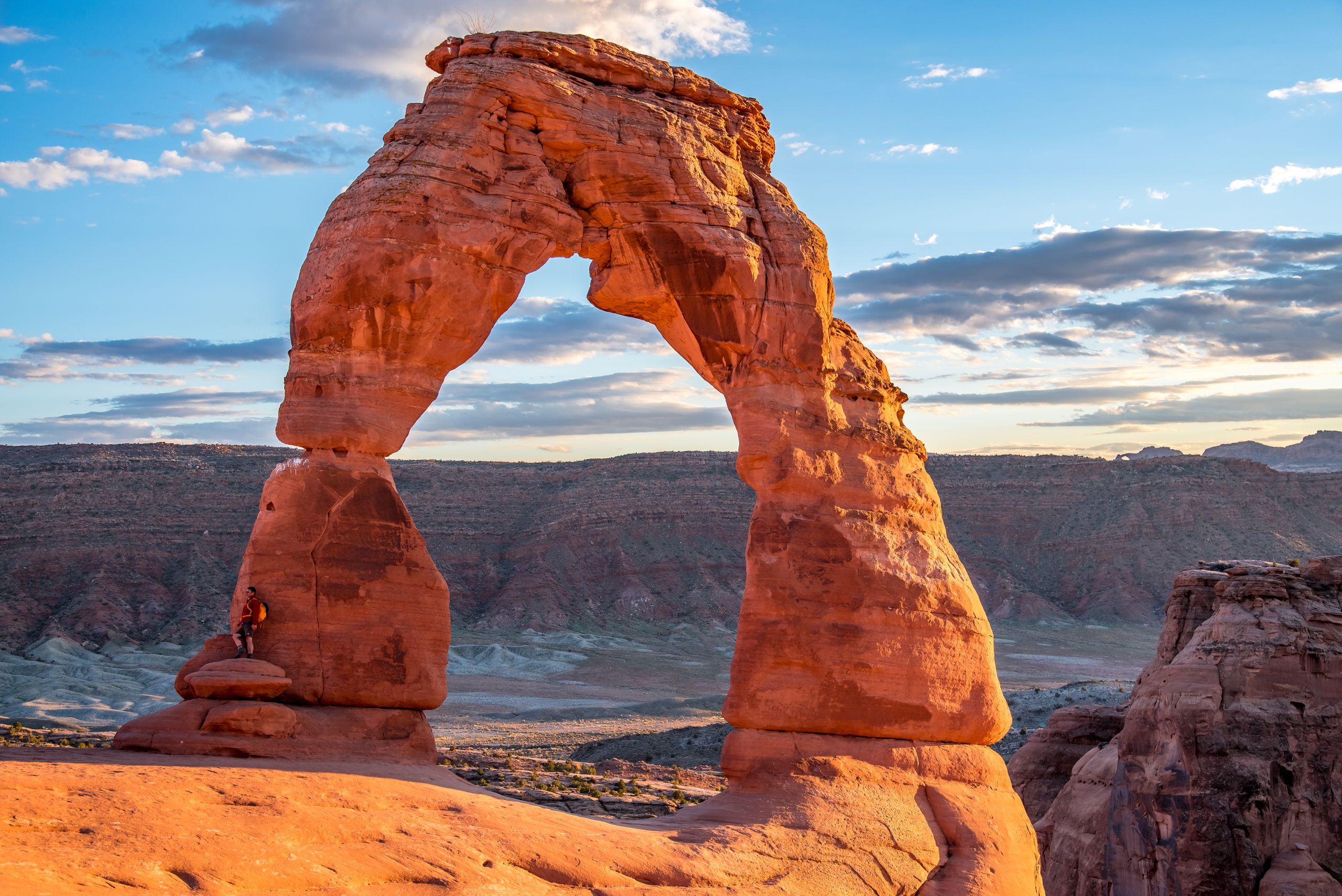
Utah’s “Mighty 5” — Zion, Bryce Canyon, Capitol Reef, Canyonlands, and Arches — pack more red rock, slot canyon, and hoodoo scenery into one state than anywhere else in the country. Done right, you can string all five together in a single week without feeling like you’re just checking boxes. Here’s a real day-by-day plan, with the driving distances, entrance fees, and two 2026 rule changes that will actually affect how you plan this trip.
The route: start in Moab, end in Zion
Run the loop east to west — Arches and Canyonlands first, Zion last — rather than back and forth. It avoids doubling back on the same highway and ends the trip at the park with the most to do, so you’re not rushing your last stop. Total driving distance for the five parks is roughly 550 miles one-way, spread over seven days: enough time to hike, not just photograph parking lots.
Day 1-2: Arches and Canyonlands, based in Moab
Both parks sit within 30 minutes of Moab, so you don’t need to pack up between them. Arches is compact — a half-day covers Delicate Arch (the 3-mile round-trip hike, not the drive-by viewpoint), the Windows section, and Devils Garden. Canyonlands’ Island in the Sky district needs its own half-day: it’s the most accessible of the park’s three districts and delivers the widest canyon views in the state.
Real change for 2026, and it matters if you’ve read an older guide: Arches dropped its timed-entry reservation system for the 2026 season — announced by the NPS on February 18, 2026, after four pilot seasons requiring an advance permit. You can now enter any time during operating hours, no reservation needed. The park still recommends arriving before 8am or after 3pm to avoid the entrance line, since parking at the popular pullouts (Delicate Arch trailhead especially) still fills up on weekends.
Entrance fees: Arches and Canyonlands are $30 per vehicle each (7-day pass, each park separate). A combined annual pass covering both is $55, but it’s restricted to U.S. residents.
Day 3: Capitol Reef
From Moab, it’s about 200 miles and roughly 4 hours to Capitol Reef — the longest single drive of the trip, so leave early. Capitol Reef is the least crowded of the five and the cheapest to enter at $20 per vehicle. It’s also the one park in the loop with a genuinely free section: much of the park outside the paid Scenic Drive corridor is open access, which is unusual among the Mighty 5 and worth knowing if you’re tight on a budget or short on time.
Stay in Torrey, the small town just outside the park entrance — it’s the only real lodging and dining base for this stretch, and it fills up in shoulder season.
Day 4: Scenic Byway 12 to Bryce Canyon
This is the drive people remember more than any single park. Scenic Byway 12 — Utah’s first All-American Road — covers 124 miles between Capitol Reef and Bryce, cutting through the Grand Staircase-Escalante National Monument. The full drive from Capitol Reef to Bryce runs about 146 miles and 3.5 hours if you don’t stop, but plan for closer to a full day: Escalante Petrified Forest State Park and the Hogback ridge section are worth the extra time, and gas gets genuinely scarce along this stretch — fill up in Torrey or Escalante, not somewhere in between.
Entrance to Bryce is $35 per vehicle. One practical detail that catches people off guard: Bryce Canyon does not accept cash at the entrance gate — cards only.
Day 5: Bryce Canyon
A full day here is the right amount — the amphitheater viewpoints along the rim (Sunrise Point, Sunset Point, Inspiration Point) can be walked in a couple of hours, but the Navajo Loop/Queen’s Garden combo hike down among the hoodoos is what makes Bryce different from a viewpoint you drive to. Go early: the park sits at 8,000+ feet and afternoon thunderstorms are common in summer.
Day 6-7: Zion
Zion to Bryce is the shortest drive of the trip — about 72-84 miles depending on the route, roughly 1.5 to 2 hours via UT-9 and US-89, including the mile-long tunnel cut through the canyon wall on the Zion-Mount Carmel Highway. Give Zion two full days if you can; it’s the most visited of the five and the one place in this itinerary where you genuinely need more time than you think.
The detail every older guide gets wrong or leaves out: from March 7 through November 28, 2026, Zion Canyon Scenic Drive — the road to most of the park’s best trailheads, including Angels Landing and the Narrows — is closed to private vehicles entirely. You ride the free park shuttle. It’s only during the off-season (early January to early March, and late November to late December) that you can drive your own car through the canyon. Plan your visit accordingly, and don’t rent a car expecting to drive straight to the trailheads if you’re coming any time between March and Thanksgiving.
Entrance is $35 per vehicle. One more fee that’s new and easy to miss: as of 2026, non-U.S. residents aged 16 and up pay an additional $100 nonresident fee on top of the standard entrance fee, unless they’re admitted with an Annual or America the Beautiful Pass. If you’re planning this trip from outside the U.S., the America the Beautiful pass isn’t just a convenience here — it removes a real, separate charge.
Should you buy the America the Beautiful pass?
Almost certainly yes, and the math is simple. Paying vehicle entrance fees at all five parks separately comes to $150 ($35 Zion + $35 Bryce + $20 Capitol Reef + $30 Canyonlands + $30 Arches). The America the Beautiful annual pass covers every NPS site in the country for a full year at $80 for U.S. residents — it pays for itself on this trip alone, with visits to spare. Non-U.S. residents pay $250 for the annual pass, which is a steeper ask, but it’s the only way to skip Zion’s $100 nonresident surcharge, and it still covers every other federal site you visit for a year.
The 7-day version, at a glance
- Days 1-2: Arches + Canyonlands, based in Moab
- Day 3: Drive to Capitol Reef (~200 mi / 4 hrs), stay in Torrey
- Day 4: Scenic Byway 12 to Bryce Canyon (~146 mi / 3.5+ hrs with stops)
- Day 5: Bryce Canyon
- Days 6-7: Drive to Zion (~72-84 mi / under 2 hrs) and explore
If you only have five days, cut a day from Zion rather than skipping a park entirely — the loop works better as five shorter stops than four full ones. For everything else on the planning side — packing, budget, route tools — the general road trip planning guide covers the basics that apply here too.